


Walk into any gym today, and you’ll see people copying exercises from professional bodybuilders, elite powerlifters, or social media fitness influencers. Heavy deadlifts with questionable form, extreme cable angles, and highly specialized isolation exercises have become the norm. The problem is that most of these routines were designed for athletes preparing for competition—not for the people who simply wants to build muscle, stay healthy, and move pain-free. Therefore, train for life, not just for competition and plan your workout accordingly.
If your goal is to look better, become stronger, improve your posture, and enjoy a long, active life, your training should reflect those priorities. You don’t need to train like you’re stepping onto a bodybuilding stage or breaking a world record.
The Purpose of Exercise Matters
A competitive bodybuilder trains to maximize muscle size and symmetry. A powerlifter trains to lift the heaviest possible weight in three specific lifts. An Olympic weightlifter develops explosive power and technical precision.
But individuals focused on lifelong fitness have very different goals:
- Improve strength for daily life.
- Build and maintain lean muscle.
- Stay mobile and flexible.
- Reduce the risk of injuries.
- Maintain heart health and metabolic fitness.
- Continue exercising consistently for decades.
When your objective changes, your exercise selection should change as well.
Example 1: The Face Pull Confusion
The face pull is one of the best exercises for shoulder health and upper back development. However, many people perform it the way they have seen competitive bodybuilders execute it during rear-double-biceps pose practice.
Instead of focusing on smooth shoulder blade movement and external rotation, they flare the elbows excessively, lean backward, or turn the movement into a posing drill.
For most people, the goal of a face pull should be simple: strengthen the rear deltoids, rotator cuff muscles, and upper back while promoting healthy shoulder mechanics. A controlled pull toward the face with moderate resistance and a full range of motion is far more beneficial than trying to mimic a bodybuilding stage pose.
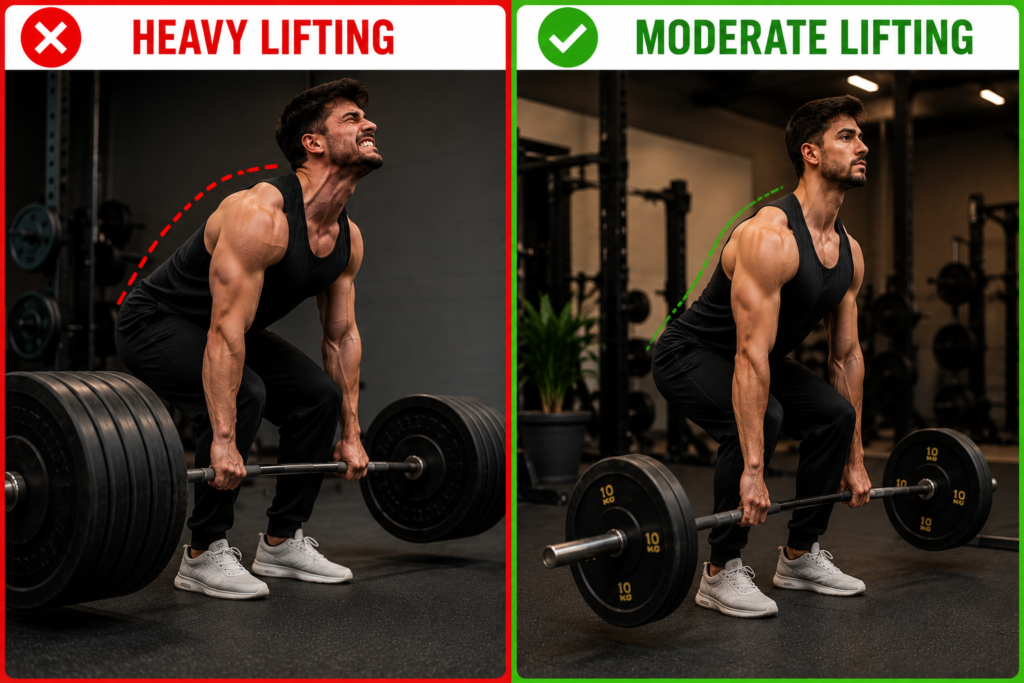
Example 2: Heavy Deadlifts Are Not Mandatory
The deadlift is a fantastic compound exercise, but there is a common misconception that everyone must pull extremely heavy weights to build strength.
For a competitive powerlifter, lifting near maximal loads makes sense because performance is the sport. For the average gym-goer, however, the risk-to-reward ratio changes dramatically as weight increases.
Moderate-load Romanian deadlifts, trap-bar deadlifts, kettlebell deadlifts, or even hip hinge variations can provide nearly all the benefits—stronger glutes, hamstrings, lower back, and core—without the excessive fatigue and injury risk associated with maximal lifting.
Remember, your body doesn’t know how much weight is on the bar. It only responds to the tension and effort placed on the muscles.
Social Media Has Changed Fitness—for Better and Worse
Many viral exercise videos are created because they look impressive, not because they are practical. Single-arm balancing cable presses, unstable Bosu-ball squats, or extreme range-of-motion exercises attract attention online but often add unnecessary complexity.
The best exercise program is usually built around movements that have stood the test of time:
- Squats and squat variations.
- Push-ups and chest presses.
- Rows and pull-downs.
- Hip hinge movements.
- Overhead presses.
- Lunges and step-ups.
- Carries and core stability exercises.
Simple movements, performed consistently and with good technique, produce excellent results.
You Don’t Need to Train to Failure Every Set
Another bodybuilding habit many people copy is taking every set to complete muscular failure. While advanced bodybuilders may use this strategy selectively, beginners and intermediate trainees often recover better by leaving one or two repetitions “in the tank.”
Training close to failure provides enough stimulus for muscle growth while reducing joint stress, excessive soreness, and central nervous system fatigue. It also allows you to maintain better exercise form, which is essential for long-term progress.
More Weight Is Not Always More Progress
One of the biggest myths in the gym is that strength only improves if you constantly increase the weight. In reality, progressive overload can happen in many ways:
- Improving exercise technique.
- Increasing repetitions with the same weight.
- Slowing down the lowering phase (eccentric control).
- Increasing range of motion.
- Reducing rest periods slightly.
- Performing an additional quality set.
These methods can stimulate muscle growth and strength gains without forcing you to chase heavier weights every week.
Mobility and Flexibility Should Not Be Ignored
Competitive bodybuilders often dedicate most of their time to resistance training, but the average person spends much of the day sitting. Tight hips, stiff shoulders, poor thoracic mobility, and weak glutes are common issues.
A well-rounded fitness routine should include:
- Dynamic warm-up exercises.
- Hip and ankle mobility drills.
- Shoulder mobility work.
- Core stability exercises.
- Regular stretching after training.
Being able to squat down comfortably, rotate your shoulders freely, or pick up a child without back pain is just as important as adding five kilograms to your bench press.
Train for the Life You Want to Live
Think about what success actually means. Is it lifting 220 kilograms for one repetition while dealing with chronic aches and frequent injuries? Or is it being able to hike, play sports, travel, carry groceries, and stay active into your 60s and 70s?
Fitness should improve your quality of life, not compromise it.
A balanced program combining safe compound movements, moderate resistance training, mobility work, cardiovascular exercise, and adequate recovery will help you build natural muscle, develop real-world strength, and stay healthy for the long term.
The Bottom Line
You do not need to train like a competitive bodybuilder or elite athlete to achieve an impressive physique and excellent health. In fact, trying to copy specialized routines without understanding their purpose often leads to frustration, burnout, or injury.
Focus on the basics. Use controlled movements, moderate weights, proper technique, and consistent progression. Build strength naturally, prioritize mobility and flexibility, and remember that fitness is not about performing the most extreme exercise in the gym—it’s about creating a body that serves you well every single day.
Train for life, not just for the camera.